In an age of rapidly advancing information technology and artificial intelligence, a form of existence that has yet to be fully identified is gradually emerging. It moves through vast flows of data, computational systems, and algorithms, quietly becoming embedded in the world we inhabit.
Under the theme Gray Autonomous Entity, the 2026 Digital Art Festival Taipei seeks, through digital art, to render perceptible these emerging forms of agency—difficult to clearly identify, yet increasingly impossible to ignore—and the relationships among life, technology, and environment that unfold through them. As vast amounts of data are encoded and fed into model training, forming new representations within high-dimensional vector spaces, images, language, and sound establish new forms of proximity. Computation identifies patterns in existing data, makes predictions, and produces new combinations, allowing systems to generate and respond while also bringing forth a certain entity that remains difficult to describe. It produces experiences that feel both familiar and unfamiliar: familiar because they draw upon data and memories collectively accumulated by humanity; unfamiliar because they arise from the emergence of automaticity.
What we recognize may originate in the experience of a single individual, or in data gathered from countless people and regenerated through computational models. Cultural traces, processed through computation, return to us in altered forms. As a symbol in everyday language, “gray” evokes ambiguity, transition, and boundaries that remain unsettled. In the development of machines, it also derives from the colors of metals and industrial materials, and has been further extended through science fiction culture, carrying with it the human desire to avoid the unease associated with the “uncanny valley.” Yet as machines generate our language, images, and sounds—and even become embodied—the boundaries between the familiar and the unfamiliar, the artificial and the natural, the subject and technology remain open and uncertain.
Like plants, soil, mycelia, animals, humans, and machines, artificial intelligence has now become part of the environment, together forming complex networks and introducing a new kind of node into them. If agency no longer belongs exclusively to humans, how might we reconsider action, perception, existence, relation, and creation? When artistic creation involves data sampling, model training, latent spaces, and generative algorithms, it also carries the histories, cultures, and structures of power accumulated within data. Bias, classification, labor, surveillance, and ethics therefore coexist with generative capacities.
Gray Autonomous Entity thus points toward realities situated between life and non-life, the natural and the artificial, control and autonomy, while envisioning an emerging ecology constituted by humans and nonhumans alike. Perhaps it is precisely within these states of uncertainty that art can make invisible forces, computations, and connections perceptible, opening up further possibilities for understanding and creating the world.
CURATORS
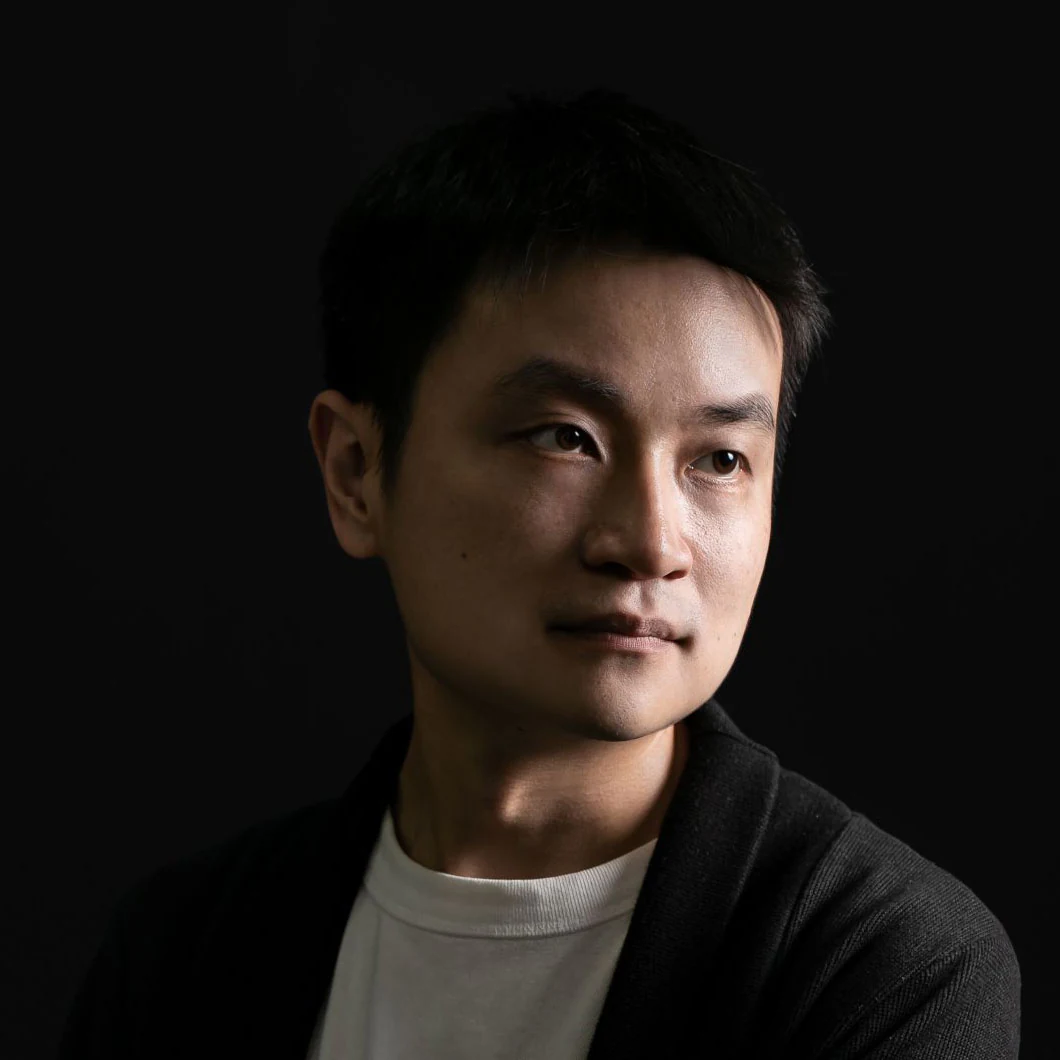
Lien-cheng Wang
Taiwan
Lien-cheng Wang is a new media artist, educator, and audiovisual performer. He is currently a full-time Assistant Professor in the Department of New Media Art at Taipei National University of the Arts. His practice focuses on interactive installation, sound, algorithmic imagery, and machine perception, with a long-standing interest in how technology intervenes in human perception, bodily experience, and social relations. Through programming, mechanical systems, and real-time computation, he develops interdisciplinary works across multiple media. His honors include First Prize in the Interactive Installation category of the Taipei Digital Art Awards, First Prize in the Taipei Digital Art Performance Awards, the 3D/Sculpture Award at the UK-based Lumen Prize, and First Prize in the Taipei Art Awards.
2025 Beyond the Machine, Kuandu Museum of Fine Arts, Taipei, Taiwan.
2023 BIENAL MADATAC #12, hispanoamérica, Madrid, Spain.
2019 PROYECTOR 2019, Medialab Prado, Madrid, Spain.
2018 Taipei Art Award, The First Prize, Taipei, Taiwan.
2018 12th Arte Laguna Prize, Nappe Arsenale Nord, Venice, Italy.
2017 Lumen Matrix - Lumen Prize for Digital Art, Today Art Museum, Beijing, China.
2017 Poland digital art festival, Małopolski Ogród Sztuki, Krakow, Poland.
2017 Ars Electronica Festival, Post City, Linz, Austria.
2017 The 4th Media Art, Gwangju Museum of Art, Gwangju, South Korea.
2017 Lumen Prize, The winner of 3D/Sculpture award, London, United Kingdom.
2017 YICCA International competition, The Rooster Gallery, Vilnius, Lithuania.
2016 UPDATE_6, Ghent, Belgium.
2013 Digital Art Performence Award, Taipei.
2009 Digital Art Festival Taipei 2009, The First Prize of Interactive installations, Taipei, Taiwan.

Yen-Ju Lin
Taiwan
Yen-Ju Lin is a new media artist, curator, and researcher. She holds an MFA in New Media Arts and a PhD in Fine Arts from Taipei National University of the Arts. Her artistic, curatorial, and research practices traverse art, information technology, and cosmological thought, examining how information, media, and systems shape both the world and artistic practice. Her work explores the relations between the real and the virtual, the visible and the invisible, and the human and the inhuman.
Grounded in her experience as an artist, Lin approaches curating as an artistic practice and a mode of creation, conceiving the exhibition as a generative field in which invisible relations and possibilities can emerge and take form. Her co-curatorial projects include Kuandu Light Art Festival – Quantum Entanglement, Zhongshan Hǎo Róng Yì – Outdated Daily, and Epicentrum, Observer Pattern, Echo Toward the Stargate, and Computational Evolution at Ars Electronica in Linz. She also curated Signal World [REC].
2026, Computational Evolution, Ars Electronica Campus, Linz, Austria
2025, Echo Toward the Stargate, Ars Electronica Campus, Linz, Austria
2024, Observer Pattern, Ars Electronica Campus, Linz, Austria
2023, Epicentrum, Ars Electronica Campus, Linz, Austria
2021, 2021 Zhongshan Hao Rong Yi – Outdated Daily, Zhongshan District, Taipei, Taiwan
2020, 2020 Kuandu Light Art Festival – Quantum Entanglement, Kuandu Museum of Fine Arts, Taipei, Taiwan
Curatorial Projects
2026, The 7th SLY Art Space Media and Moving Image Exhibition — Signal World [REC], SLY Art Space, Taoyuan, Taiwan
Journal Articles
2024, “Trans-dimensional Messenger: Artworks as a Media for Information Transmission”, Journal of Taiwanese Art, No. 129, National Taiwan Museum of Fine Arts.
Solo Exhibitions
2017, Long Stay – Yen-Ju Lin Solo Exhibition, FreeS Art Space, Taipei, Taiwan
Selected Group Exhibitions
2026, Can You See Me Now?, The Gem Theater / VTIFF, Bethel, ME / Burlington, VT, USA
2024, The Interest from the Street Corner, MOCA Taipei, Taipei, Taiwan
2021, Non-syntax, Calm & Punk Gallery / BnA Museum / Workshop Underground, Tokyo / Kyoto / Fukuoka, Japan
2021, Groundless, Pa Ta Taipei – PTT Space, Taipei, Taiwan
2013–2015, Schizophrenia Taiwan 2.0, Ars Electronica / transmediale / Maison des Métallos / Ambika P3 / Instants Video Festival / HELLERAU – European Centre for the Arts, Linz / Berlin / Paris / London / Marseille / Dresden, Austria / Germany / France / United Kingdom / France / Germany
2013, 8th Digital Art Festival Taipei – Data-Neurons, Songshan Cultural and Creative Park, Taipei, Taiwan